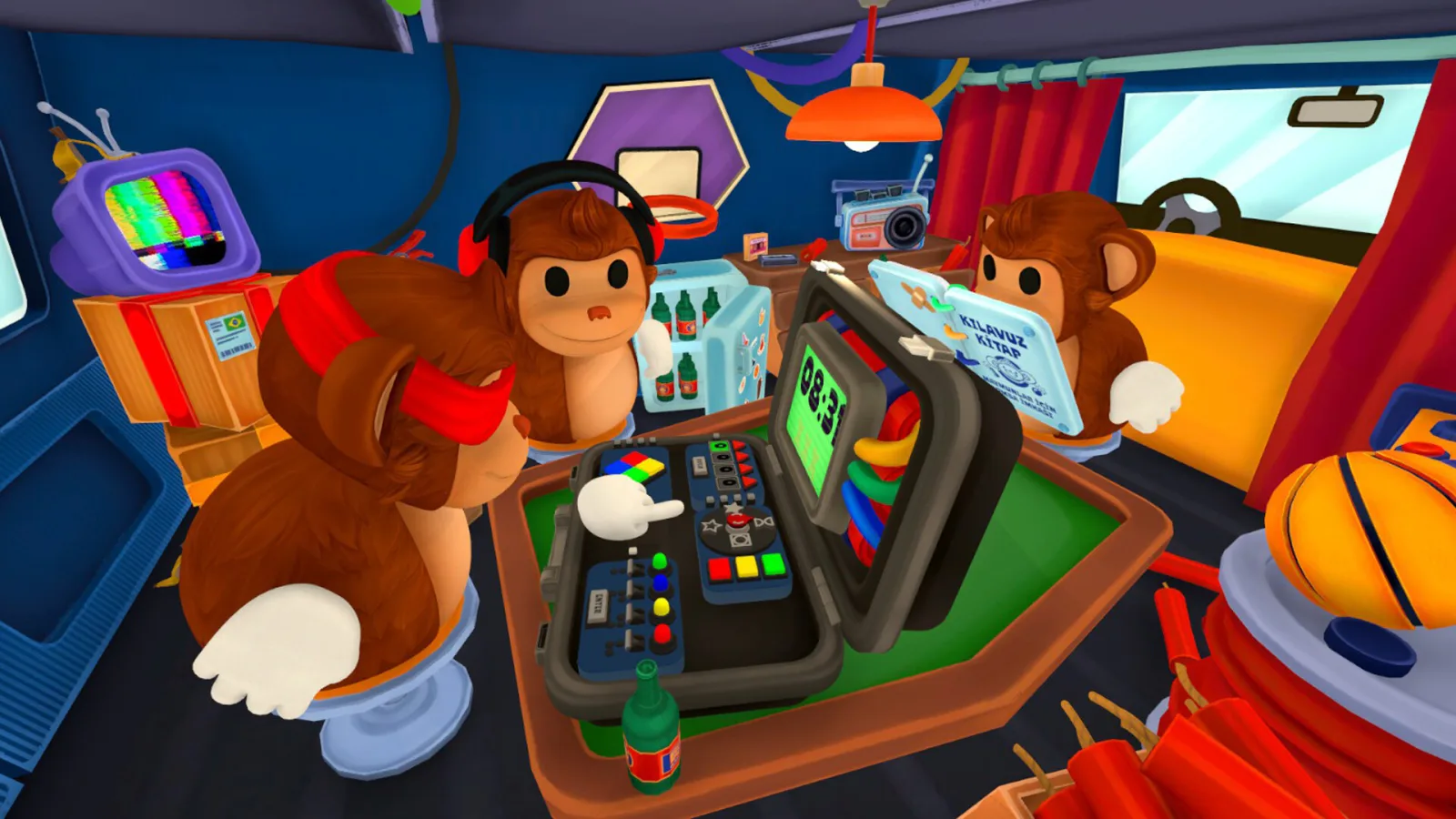
Mastering the Bombanana Controversial Morse Code Minigame
Discover how to conquer the Bombanana controversial morse code minigame with our expert Roblox guide, covering role strategies, decoding, and solve tips.
Published:
Table of Contents
The Challenge of the Morse Code Module
In the high-stakes environment of TARK Games' hit title, communication is the only thing standing between survival and a sudden explosion. Among the various puzzles players face, the bombanana controversial morse code minigame has earned a reputation for being the ultimate team-tester. While other modules rely on quick reflexes or simple pattern matching, Morse code demands a level of synchronization that often leads to heated debates and failed runs.
This specific module is frequently discussed in community circles because it splits vital information across different players. One person might see the location of the input, while another hears the signal, and a third holds the key to the translation. Navigating the bombanana controversial morse code minigame requires more than just knowing dots and dashes; it requires a structured communication protocol that can withstand the chaos of a ticking bomb.
Quick answer
The Morse Code module requires players to identify which of the four display slots is active (indicated by a green flash) and decode a five-signal audio pattern into a digit (0-9). Success depends on separating "slot identification" from "signal decoding" to ensure the right number ends up in the right position before hitting Enter.
Understanding the Module Interface
Before diving into advanced strategies, players must understand what they are looking at. The Morse module consists of four numerical displays, a flashing indicator system, and a final "Enter" button. Unlike other modules where you can simply click through options, the Morse module is cyclical and time-sensitive.
According to community reports, the most common initial mistake is misinterpreting the green flashes. New players often try to count how many times a slot flashes, assuming that number is the answer. However, the flash is merely a pointer. It tells you which of the four "positions" is currently broadcasting its audio signal. If the third slot is flashing, the Morse code you hear at that exact moment corresponds to that specific display.
Component
Visual/Audio Cue
Purpose
Display Slots
Four numbered boxes (0-9)
Where the decoded digits are entered.
Green Flash
Visual pulse on a specific slot
Identifies which position the current audio belongs to.
Audio Signal
Series of short (dot) and long (dash) beeps
The encoded digit for the active slot.
Enter Button
Large button below the displays
Submits the four-digit sequence for verification.
Role-Based Strategy for Success
Because information is siloed, teams usually adopt a three-role system. This is where the bombanana controversial morse code minigame earns its "controversial" label, as a single player's mistake can mislead the entire group. Based on player experience, the most effective way to handle this is by assigning clear responsibilities to the "Deaf," "Blind," and "Mute" roles (or their equivalents in your specific group).
The Role of the Observer (The "Deaf" Monkey)
The player who can see the screen but perhaps cannot hear the audio (or is focusing on visual cues) is responsible for slot identification. Their job is to shout out the position—"Slot 1," "Slot 2," etc.—the moment the green light begins to pulse. Without this information, the listener has no idea where to put the data they are collecting.
The Role of the Listener (The "Blind" Monkey)
The listener focuses exclusively on the audio. They must block out the background music and the sounds of other modules to hear the five-signal pattern. They don't need to know what the code means; they just need to relay the sequence of "dots" and "dashes" to the decoder.
The Role of the Decoder (The "Book Boy")
The decoder holds the manual. They take the dots and dashes provided by the listener and convert them into a digit. Once converted, they tell the team which number to input into the slot identified by the observer.
Role
Primary Task
Critical Information
Observer
Watch the slots
"Position 3 is active!"
Listener
Hear the beeps
"Dot, Dot, Dash, Dash, Dash!"
Decoder
Check the manual
"That sequence is the number 2."
The Morse Digit Lookup Table
Every digit in the bombanana controversial morse code minigame is composed of exactly five signals. This is a crucial detail. If you only hear four sounds, you haven't finished the digit. Missing the final signal is a frequent cause of failure because several numbers start with the same sequence. For example, ....- is 4, while ..... is 5. If you stop listening after the fourth dot, you have a 50/50 chance of blowing up.
Use the following table to translate the signals found in the official BOMBANANA! Roblox page documentation and community guides:
Digit
Morse Pattern
Memory Aid
0
-----
Five long dashes
1
.----
One dot, four dashes
2
..---
Two dots, three dashes
3
...--
Three dots, two dashes
4
....-
Four dots, one dash
5
.....
Five short dots
6
-....
One dash, four dots
7
--...
Two dashes, three dots
8
---..
Three dashes, two dots
9
----.
Four dashes, one dot
Why the Module is Considered Controversial
The bombanana controversial morse code minigame isn't controversial because it's buggy; it's controversial because it punishes "partial knowledge." In many other Roblox puzzles, you can guess the last part of a sequence or brute-force a solution. In Morse, a single misplaced digit in the four-slot sequence renders the entire effort useless.
Community discussion on platforms like Steam suggests that the "Position vs. Digit" confusion is the primary source of frustration. Players often argue over whether a number belongs in the slot that was flashing or the slot that is flashing. Because the audio and visual cues loop, it is easy to lose track of the cycle.
The Position Trap
Never input a number unless you are 100% certain which slot was flashing when the audio started. If you lose track of the position, it is always faster to wait for the next loop than to guess and fail.
Step-by-Step Solve Protocol
To consistently clear the bombanana controversial morse code minigame, teams should follow a disciplined workflow. Randomly shouting numbers will lead to disaster. Instead, use this structured approach:
Clear the Air: When the Morse module is active, the listener should ask for "Morse Silence" so they can hear the faint beeps over the game's chaotic soundtrack.
Identify the Slot: The observer calls out the active slot (e.g., "Slot 2 starting now").
Capture the Five Signals: The listener calls out each dot and dash as they hear it. Do not wait for the end of the sequence to start talking.
Translate and Verify: The decoder matches the five signals to the table.
Input but Don't Submit: Enter the digit into the display.
Repeat for all Four Slots: Continue until all four displays are filled.
Final Confirmation: Before hitting "Enter," the observer should verify that the numbers match the sequence the team recorded.
Step
Action
Why it Matters
1
Announce Slot
Prevents putting the right number in the wrong box.
2
Count 5 Signals
Ensures the digit is complete and not a partial read.
3
Reference Table
Eliminates "guessing" based on how the beeps felt.
4
Verify Order
The most common error is swapping two correct digits.
Advanced Tips for High-Pressure Rounds
When the timer is low and multiple modules are demanding attention, the bombanana controversial morse code minigame becomes even more difficult. Experienced players use a "skip and loop" technique to maintain efficiency.
If a team member gets distracted by a "Slider" or "Pressure" module halfway through a Morse sequence, they should immediately call for a "Skip." Instead of trying to guess the remaining two or three signals, the team ignores that specific slot and waits for the cycle to move to the next one. This prevents "dirty data" from entering the sequence. It is much easier to fill a blank slot later than it is to find and correct a single wrong digit in a full four-number string.
Another tip from community reports involves the "Deaf" monkey memorizing the sequence of slots. The module typically cycles through the slots in a predictable order (though not always 1-2-3-4). If the team knows that Slot 3 always follows Slot 2, the listener can prepare mentally for the next burst of information.
Handling the "Enter" Submission
The final step is clicking the "Enter" button. This is the moment of truth. If the module does not clear, the team must resist the urge to simply press Enter again or change a random number.
A failed submission means one of four things happened:
A signal was misheard (e.g., a dash was thought to be a dot).
A digit was decoded incorrectly from the manual.
The right digit was placed in the wrong slot.
The input was changed accidentally while navigating the UI.
The fastest way to recover is to wipe the mental slate clean for the suspect slots. If the team is confident in slots 1 and 2 but argued about slot 3, they should only re-listen to slot 3. However, if the entire sequence is in doubt, a full reset is necessary to avoid wasting time on a broken string.
FAQ: Bombanana Morse Code Minigame
Why is the Morse code module so difficult?
The bombanana controversial morse code minigame is difficult because it requires three distinct types of information—position, sound, and translation—to be perfectly synchronized across a team. Most failures come from misidentifying which slot is currently "active" when the audio plays.
Do I need to memorize Morse code to play?
No, you do not need to memorize it. The game provides a manual (or you can use the lookup table provided in this guide). The key is accurately identifying the five-signal pattern for each of the four slots.
What should I do if I miss the start of a signal?
If you miss the beginning of an audio sequence, do not try to guess the digit. Wait for the module to cycle through the other slots and listen to it again from the start. Guessing frequently leads to a strike, which reduces your remaining time.
How many digits are in the final code?
The Morse module requires a four-digit sequence. Each of these four digits is represented by a five-signal Morse pattern (dots and dashes). Once all four digits are correctly entered into their respective slots, you must press the "Enter" button to clear the module.